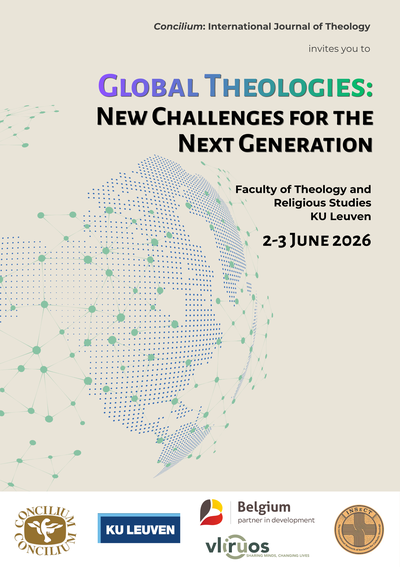
Conference Theme
In the past few decades, theology has become more inclusive of global perspectives. New methods in contextual, intercultural, and postcolonial and decolonial theology have been developed, and are now being shared and applied by many theologians worldwide. Some of these methods have academic value or are employed by scholars working at universities in North America and Europe. Others are directed at concrete capacity building for church communities, and religious and political organizations in underprivileged contexts worldwide. Under Pope Francis, the Catholic Church has refocused the work of dicasteries (e.g. the Dicastery for Promoting Integral Human Development and the Dicastery for Evangelization) towards a global awareness, opening new prospects for the work of theologians.
In the meantime, new political developments and new forms of knowledge production and communication are challenging the place of theology in the university in certain regions, while offering opportunities for theologies in the existential peripheries in other areas. What will global theologies look like in the near future? What are their tasks and challenges in a variety of contexts and political situations? What can global theologies learn from one another?
Concilium’s mission states that the aim of the journal is to “provide a meeting place for a global conversation inviting diverse perspectives on important theological issues.” The journal has been at the forefront of doing theology globally and continues to seek ways of fostering and contributing to lived theologies in situations of social, economic and eco-logical inequality. Considering the different and changing contexts in which theologies emerge, the journal seeks new ways of addressing diverse communities of readers, while also wishing to represent and speak to a global ecclesial community. What are the challenges that Concilium faces in its desire to be one of the leading journals for global theology?
The host of this conference, the Faculty of Theology and Religious at KU Leuven, has a longstanding experience with international programs for theology students, who currently come from more than seventy countries worldwide. What types of theological education do students with diverse background experiences hope to receive and learn from in Leuven? How do professors and doctoral supervisors teach and accommodate global perspectives, while representing, in most cases, only one perspective? What are the struggles and challenges of becoming a global theological community?
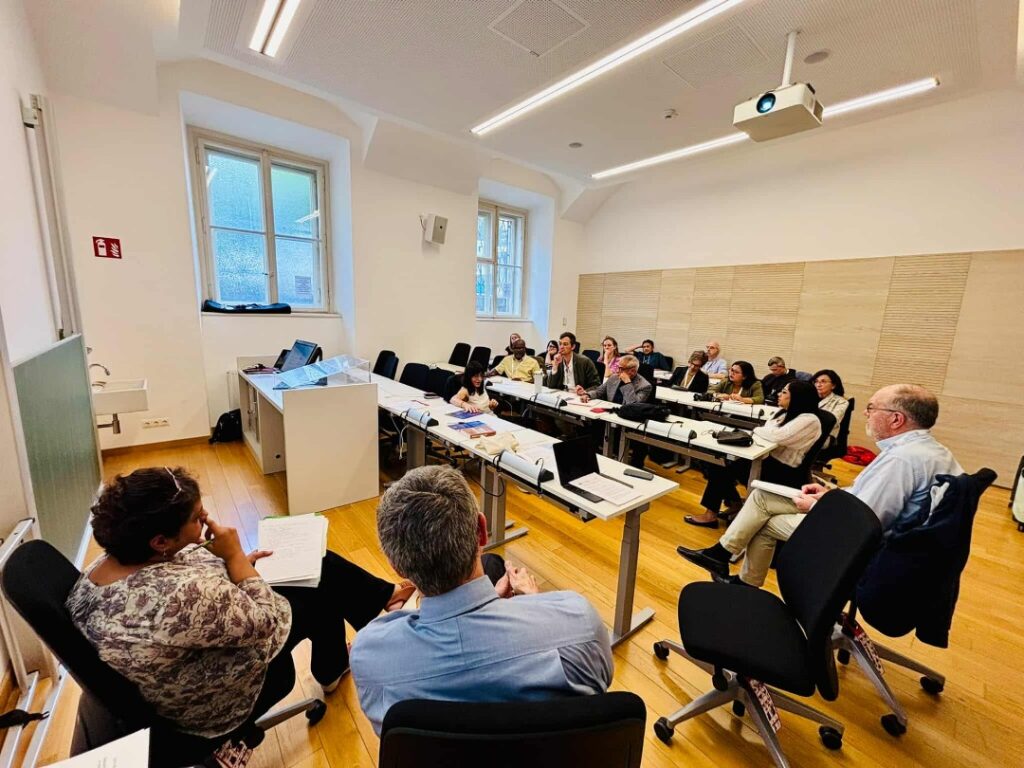
Venue: Maria Theresia-College, 02.15 (Sint-Michielsstraat 6, Leuven)
Registration required (by May 20) via this form.
Program
June 2, Tuesday (Maria-Theresiacollege 02.15)
09.00 – 09.15
- Prayer
- Welcome by the Dean of the Faculty of Theology and Religious Studies, KU Leuven, Bénédicte Lemmelijn
- Welcome by the President of Concilium, Susan Abraham
09.15 – 10.45 Session I.1: From Center to Circulation: Methods and Contexts of Doing Theology Globally
Chair: Stephan van Erp (KU Leuven, Belgium)
- Judith Hahn (University of Bonn, Germany)
Glocal Law: How to Study the Legal Framework of Global Catholicism - Nora K Nonterah (Kwame Nkrumah University of Science and Technology, Kumasi, Ghana)
A Sankofa Approach Relational Approach to Keeping the ‘Theo’ in Theology - Respondent: Geraldo Luiz de Mori (Faculdade Jesuíta de Filosofia e Teologia, Belo Horizonte, Brazil)
10.45 – 11.15 Refreshments
11.15 – 12.45 Session I.2: From Center to Circulation: Methods and Contexts of Doing Theology Globally
Chair: John Baptist Antony (National Biblical Catechetical Liturgical Centre, Bangalore, India)
- Kiran Joy OP (Antwerp, Belgium)
- Wilibaldus Gaut SVD (Ledalero Institute, Flores, Indonesia)
Being at the Margins: Doing Theology in the Church, Academia, and Society - Respondent: Jonas Hagedorn (Theologische Fakultät Paderborn, Germany)
14.00 – 15.30 Session II.1: Forming the Next Generation of Theologians in a ‘Global’ Faculty – Students
Chair: Leo Guardado (Fordham University, US)
- Dara Straub & George Nembunzu Mizingi (KU Leuven, Belgium)
- Eric Tomasini (KU Leuven, Belgium)
- Stephy Joseph (KU Leuven, Belgium)
15.30 – 16.00 Refreshments
16.00 – 17.30 Session II.2: Forming The Next Generation of Theologians in a ‘Global’ Faculty – Supervisors
Chair: Brian Robinette (Boston College, US)
- Judith Gruber (KU Leuven, Belgium)
- Nenad Polgar (KU Leuven, Belgium)
- Ellen Van Stichel (KU Leuven, Belgium)
18.00 – 19.30 Ladies of Bethany Chair Reception (Rectoral Salons)
June 3, Wednesday (Maria-Theresiacollege 02.15)
09.00 – 09.15 Prayer
09.15 – 10.45 Session III: The Infrastructures and Accessibility of Global Theology
Chair: Antonina Wozna (University of Wuppertal, Germany)
- Linh Hoang & Stephanie Ann Puen (International Network of Societies for Catholic Theology – InSeCT)
- Bryan Froehle (Palm Beach Atlantic University, US) on the Global Catholicism Series
- Stan Chu Ilo (De Paul University, Chicago, US) on PACTPAN and the Church of the Sheaves Project of the Dicastery for Evangelization
10.45 – 11.15 Refreshments
11.15 – 12.45 Palaver: A Polyphonic Reflection on Global Theology, and the Role of Concilium
Chair: Nora K Nonterah (Kwame Nkrumah University of Science and Technology, Kumasi, Ghana)
- Judith Gruber (KU Leuven)
- Silvia Martinez Cano (Universidad Complutense, Madrid, Spain)
- Maricel Ibita (Ateneo de Manila University, Philippines)
- César Kuzma (Pontifical Catholic University of Parana, Brazil)